Two Bikes, Many Lessons: Homage5 vs Bianchi
Date: 20/11/2026
If you have knee, back, or heart issues I can't recommend enough an e-bike that is programmable and adjustable.
My Riese & Müller Homage5 is in the shop this week for its annual service, so I’m riding a Bianchi Impulso Pro — a carbon gravel bike with Shimano GRX shifters on a drop bar. I could not have asked for a better controlled experiment. Almost a year of riding the Homage5 had taught me what it does. After a few days riding a conventional, high-quality bike taught me why it matters for a 69-year-old training for a long tour. None of this is criticism of the Bianchi. It is an excellent machine, built precisely for what it is built for. But that purpose is not mine, and the differences say something worth sharing.
Shifting: Thumb Versus Thought
On the Homage5, changing gears is the flick of a thumb. Up or down through the entire 600% range, whether I am pedalling hard, coasting, or standing completely still. When I stop at a traffic light, I tap my way to the best gear before the light turns green, so my first pedal stroke never loads my knee. When I coast downhill, the gearbox anticipates my higher cadence and pre-selects a better gear on its own. On the Bianchi, shifting requires a small negotiation: which lever, which position, easing the pedal pressure so the chain lands cleanly, and hoping the gear I picked suits the slope. Two taps of the thumb on the Homage5 replace all of that. After a year, it has made me impatient with conventional shifting — and the impatience itself is the finding. Gear management should be effortless, because at my age every unnecessary surge of knee torque is a cost and a potential injury or set-back.
Assistance: A Dial, Not a Cliff
The Bianchi has exactly one assistance level: none. The Homage5 offers five finely programmable levels between zero and maximum, and I can adjust mid-ride without breaking stride. On a good joint day I ride Eco or assist-off. On a compromised day, moderate assist holds me in my endurance zone instead of letting gravity grind my knees on a rigid frame. The psychological effect surprised me. Knowing the higher levels are there on bad days makes me more likely to ride — the dial removes the all-or-nothing choice between a punishing ride and skipping it entirely. That is how consistency gets built, and consistency is the whole method.
Comfort: 80 km Without Padding
I have ridden 80 km on the Homage5 in plain shorts, without padding, and finished fresh. After 20 km on the Bianchi, padded shorts were not optional — and even then, every pothole and gravel vibration arrived unwelcome at my wrists, butt, spine, neck and shoulders. The difference is suspension: 120 mm at the front and rear on the Homage5 absorbs what the Bianchi's carbon frame passes straight through. Over a long tour, that cumulative difference is not comfort trivia; it is the difference between riding again tomorrow and needing a rest day.
Position: The Neck Has Opinions
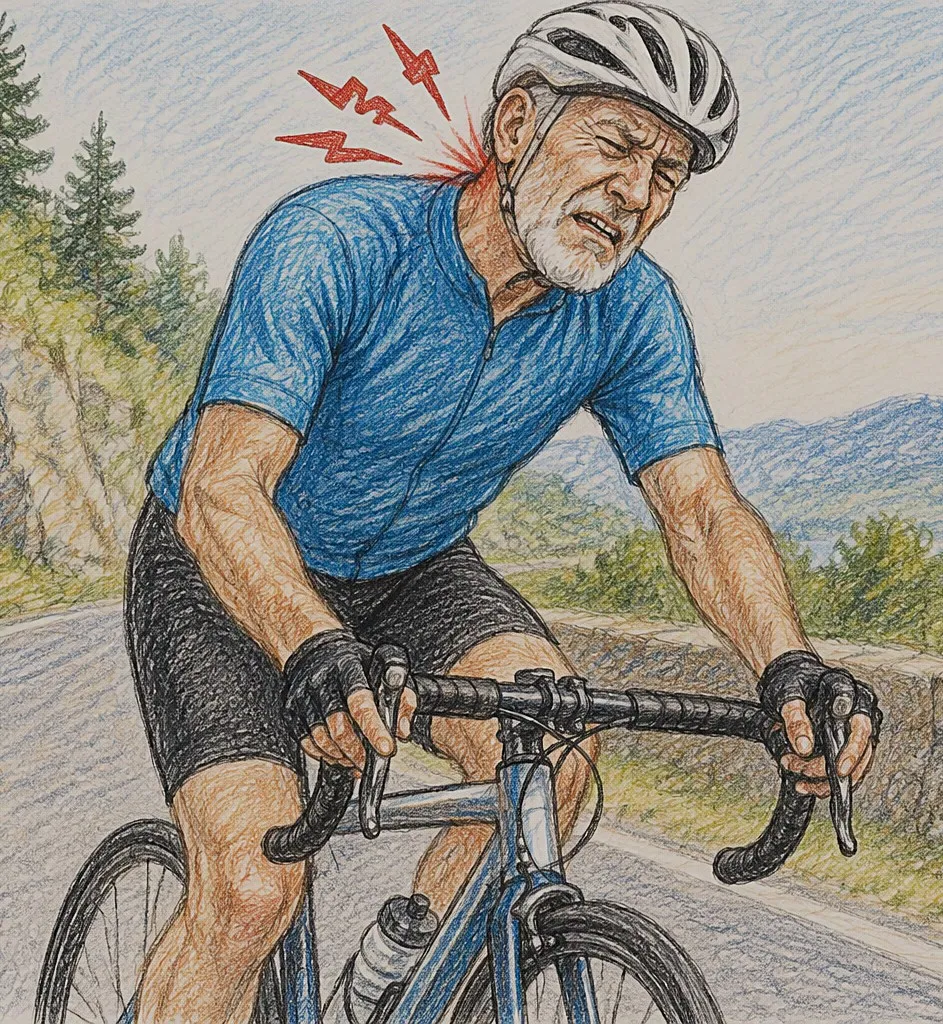
Drop bars are aerodynamic, and the Bianchi is genuinely fast on gravel. But at 69, after decades hunched over a desk and a computer screen, my compressed spine does not forgive a position that extends the neck and loads the lower back. Within an hour my neck was complaining; the discomfort was real. This geometry is correct for its design purpose — speed on gravel — but speed on gravel is not my priority. Staying upright, comfortable, and able to look confidently at traffic and trail ahead is. Add to that I love riding along rivers and through woodlands and enjoying the scenery.
The Display: Training Data Where My Eyes Are
On the Bianchi I used a phone for route navigation, and while it tracked my heart rate, I had to glance at a separate app to see it. On the Homage5, heart rate is feed to the same screen as my route, gear, speed, and cadence. Holding my effort zone is the core of my training method, and holding it requires seeing the numbers while riding, not reconstructing them afterwards. It sounds minor; in practice it is a training-tool difference, not a gadget difference.
Weight: Coffee Cup Versus Anvil
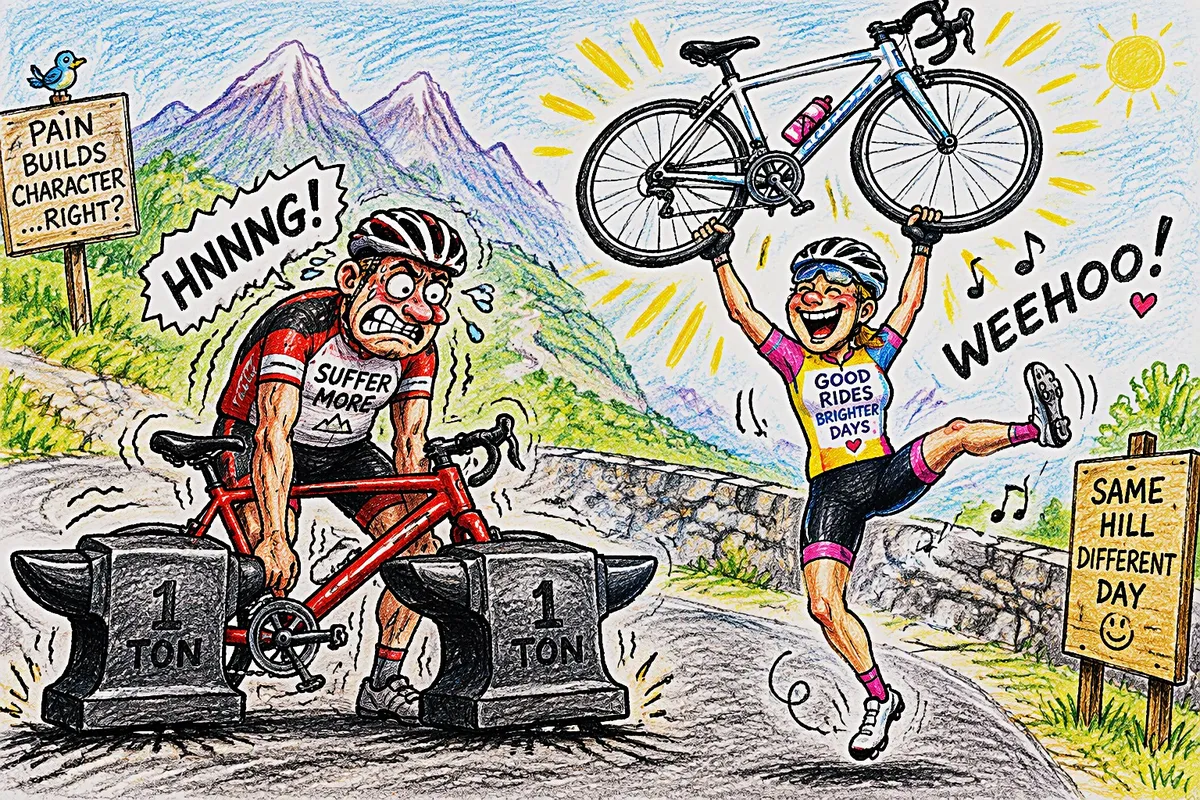
Picking up the Bianchi is like lifting a cup of coffee. Picking up the Homage5 — nearly 40 kg with bags, tools, and water — is like lifting an anvil. Weight is the Bianchi's clearest advantage, and I will not pretend otherwise: it accelerates instantly, climbs willingly under nothing but leg power, and has shown me exactly what my legs alone can do. I have genuinely enjoyed knowing that.
But knowing what my legs can do and building and maintaining it, day after day, are different jobs. The Homage5 is the tool for the second job. The Bianchi exercises my fitness; the Homage5 grows it.
Stopping and Starting: Protecting the Knees
The Homage5's adjustable dropper seatpost lets me put a foot down flat at every light without dismounting. Combined with shifting while stationary, this removes two of the most common knee-injury moments in cycling: twisting off the saddle at low speed, and stamping a hard first pedal stroke from a standstill in the wrong gear. On the Bianchi, both risks reappear on every ride in town.
Maintenance: A Year of Washing
In almost a year of ownership, the only maintenance my Homage5 has needed is washing. No oiling, no derailleur adjustment, nothing. The Pinion MGU is a sealed gearbox needing an oil change every 10.000 km — during which time a conventional derailleur will have been trued, cleaned, re-cabled, and cursed at, especially through a winter of wet gravel. Less fiddling means more riding, and more riding is the point.
The Closing Argument
Could I ride the Bianchi from northern Europe back to Spain in about five months? I cannot imagine it. Not because the bike is inadequate — it would carry me fine on smooth days. It is the accumulation: the neck, the unpadded kilometres, the knee risk at every restart, the absence of assistance for bad days, and the recovery cost arriving unforgiven night after night. A long tour is not won by the fastest bike; it is won by the bike that lets you show up every morning.
That is what the rental week taught me. The Bianchi showed me my limits. The Homage5 is how I plan to spend months ignoring them and enjoying great scenery, eating great food, and meeting interesting people.
Medical disclaimer: I am a 69-year-old sharing a personal training journal, not offering medical advice. Consult your physician before beginning any exercise program. Tags: #EbikeTraining, #GearReview, #AgeAndEndurance, #RieseMuller, #Bianchi, #Homage5, #PinionMGU, #ShimanoGRX, #BikeComparison, #BikeTouring