Introduction: Why Strength Training Rides Alongside the Bike
Tags: #EbikeTraining #AgeAndEndurance #StrengthTraining #TourFit2027
Cycling builds strong heart, lungs, and legs. What it does not build — and can quietly take away — is the rest of you. That is why my training plan includes two short strength sessions per week, alongside the riding. Almost two years ago I began exercising and while I lost fat, I also lost muscle. This wouldn't have happened if I were 40. But my 69 year old body is different.
The Problem Strength Training Solves
Riding a bike holds the body in one shape: hunched forward toward the bars, shoulders rolled in, back curved. Add natural age-related muscle loss (sarcopenia) on top, and two things happen:
- Imbalance: the muscles that pull — rows, pulls, posture — weaken relative to the pushing muscles. Cyclists get push-dominant; posture suffers.
- Fragility: fitness without muscle mass is fragile. I track muscle mass monthly (my floor is 57 kg) precisely because the bike alone will not protect it.
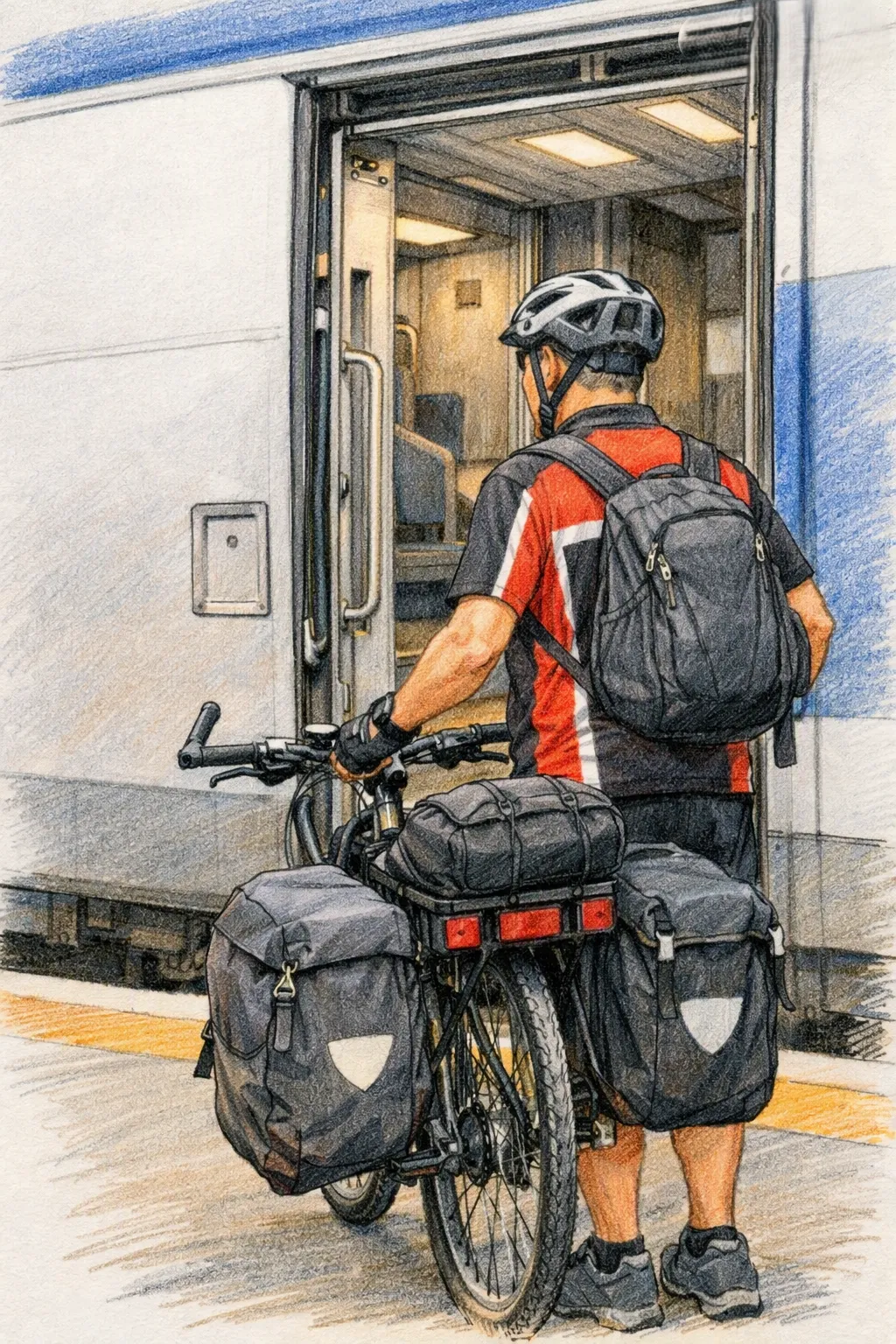
And there is a third reason: in summer 2027 I will be riding loaded — bags and supplies. I will be lifting the bike onto trains and up steps. Loading and lifting a touring bike every day demands shoulders, arms, and a trunk that the riding itself never trains.
What the Sessions Look Like
The routine is deliberately modest: two 30-minute sessions per week, usually Tuesdays and Thursdays, on days I don't cycle, using resistance bands, a bench, a mat, and light dumbbells (5,5 / 7,75 / 10 kg).
Routine A — Pull and Posture (first session of the week). Built around the mirror image of the cycling position:
- Band row — the highest-priority exercise in the whole program. Pulling the shoulders back and squeezing the shoulder blades directly counteracts the rounded cycling posture.
- Incline push-up, one-arm dumbbell row, band face pull — chest and back work in balanced proportion.
- Seated overhead press, side plank — shoulder strength and trunk stability for handling a loaded bike.
Routine B — Push, Shoulder Health, Trunk Stability (second session, minimum 48 hours later, never the day before the Sunday long ride):
- Dumbbell bench press, band lat pulldown, seated lateral raise — balanced push/pull strength.
- Scapular push-ups and band external rotations — small, precise movements targeting the rotator cuff and shoulder blade mechanics. Unglamorous, but these keep 69-year-old shoulders reliable.
- Bird dog and dead bug — slow trunk-stability work with the lower back protected throughout.
A 5-minute mobility finish (chest stretch, thoracic rotation, shoulder wall slides, tandem stance) closes each session.
Why Twice a Week — and Why So Cautious?
The frequency and the style are both deliberate choices for my age:
- Twice weekly is the minimum effective dose for muscle and tendon adaptation, while leaving room for four to five riding days. Strength supports the riding; it never replaces it.
- Never to failure. Every set stops with 2–3 repetitions in reserve, effort 6–8 out of 10. At 69, recovery between sessions matters as much as the stimulus.
- Slow loading. New weights are held at least two weeks before progressing — muscle adapts faster than tendons, and connective tissue needs a longer history of loading before it tolerates more.
- Deliberately excluded: decline push-ups, burpees, handstands, bicycle sit-ups. Fall risk and repeated spinal flexion are simply not worth the trade at my age. The aim is many years of a strong, fit life - not a spectacular gym body.
How It Fits the Plan
The strength work is the "Preservation" half of my training philosophy: the riding builds the engine, the weights keep the chassis intact. In the early phase it maintains muscle while weekly kilometres climb. Later — Phase 3, loaded touring rehearsals — it becomes job-specific: hauling panniers on and off the bike, lifting the loaded bike onto trains, holding posture through a long day in the saddle.
Next month's check-in will report what the scale says about whether it is working.
Data Sources: Renpho body composition scale; TF2027 strength routine established 24/09/2026.
Disclaimer: This is my personal training plan. It is not medical or training advice, and I am not recommending it to anyone. Consult your own doctor before starting or changing any exercise program.